
Human Judgment at the Heart of AI-Native Engineering: Notes from WeAreDevelopers 2026
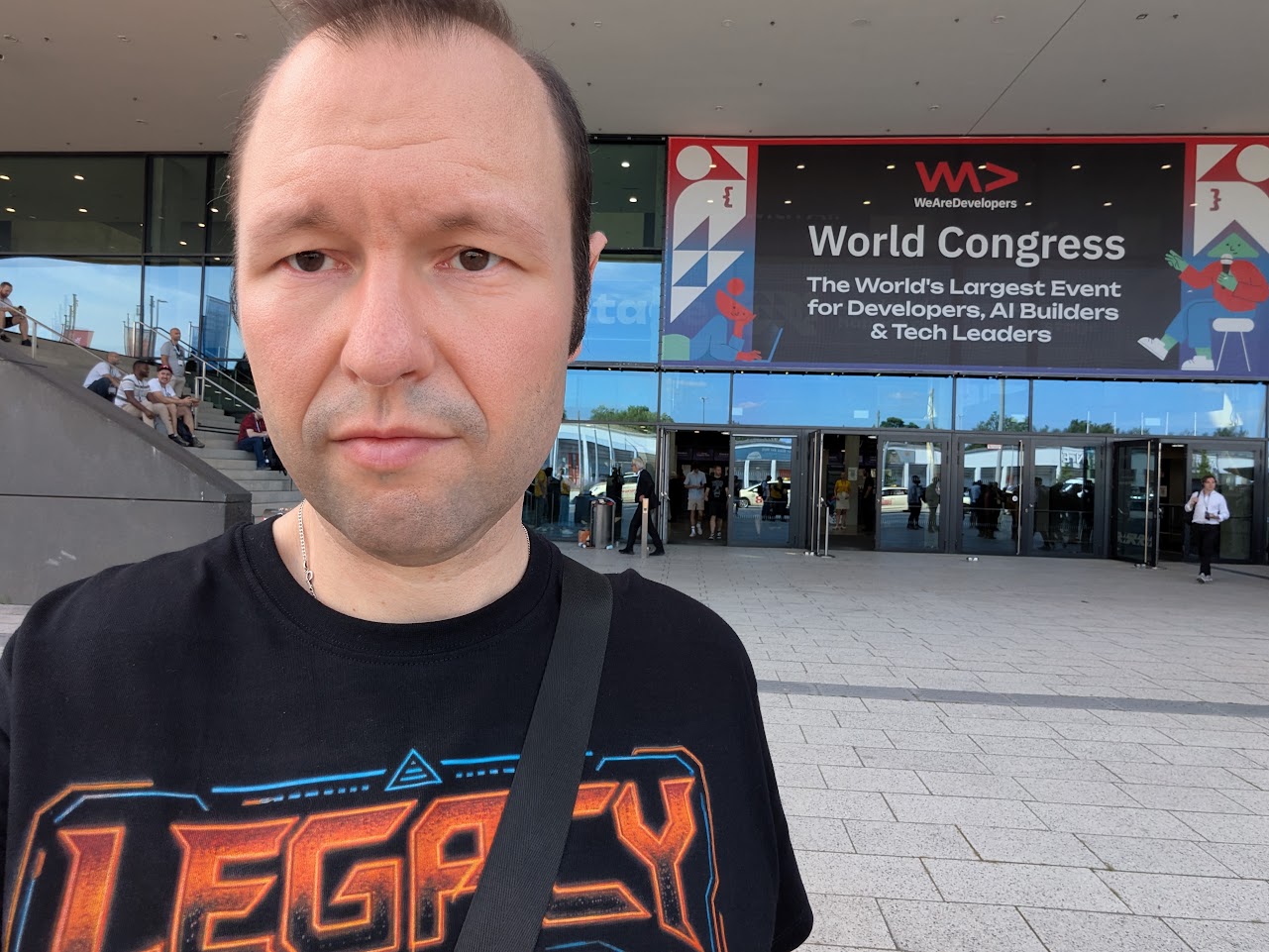
Erbis VP of AI Vitalii Zborovskyi spent two days at WeAreDevelopers World Congress 2026 in Berlin and found that every talk circled one question: what happens to human intent when machines run most of the software loop?
Software is a socio-technical system, and AI has made one of its two halves almost free. This post follows the thread of Vitalii’s conference synthesis, from “the SDLC as we knew it is dead” to cognitive debt, from blameless postmortems to AI-native software teams, along with the engineering “organs” that keep human intent alive as more of the loop becomes automated.

Code got cheap, and the bottleneck moved
Former GitHub CEO Thomas Dohmke opened with the line that framed the following two days: “The SDLC as we knew it is dead.” The IDE is now a fallback instead of the default, and pull-request volume is up as much as 3×. With AI in the loop you can see what changed. The reason behind the change gets harder to find.

Mobioos put numbers on the volume. Their estimate counts about 780 lines of code plus prompts per developer per day in the pre-AI era (1975 to 2023), about 1,300 with AI pair programming, and a projected 3,840 by 2030. Most of that output is overhead: AI-generated code ran at roughly 75% overhead, and about 80% of what gets produced never ships to production.

Judgment became the scarce resource
The strongest talk of the two days covered cognitive debt. Once information is abundant, the limit is the human capacity to turn information into judgment, and that capacity runs on three exhaustible faculties: sustained attention, working memory, and inhibition, which is the ability to resist an answer that looks right at a glance. Overload them and you get what the speaker called “AI brain fry”: more decision fatigue, more errors, and a higher likelihood that people quit.

The same logic shows up at organization level. A talk on building 10x organizations cited Deming’s estimate that 90 to 95% of an organization’s productivity is set by the system, and the Peopleware finding that top-quartile developers outperformed the bottom quartile by 2.6× largely because of their environment: quiet, space, freedom from interruption. Teams that perform well protect 60 to 90 minutes of uninterrupted focus.
The humans were always the system
Several speakers who never coordinated reached the same conclusion. Wolff’s sociotechnical review work says that when the organization works, technical problems usually get solved, so review the organization along with the code. A talk on blameless postmortems suggested replacing “we should communicate more” with “what org dependency required the communication?” A software archaeologist summed it up: the environment is part of the product, AI cannot resolve human behavior for you, and trust is a currency.

Mercedes-Benz offered the constructive version. Their core belief is that AI scales through capable people. They surveyed more than 3,000 developers to map the real ecosystem, coach AI literacy, review judgment and context discipline, and scale through “AI-Belt” trainings. Standardization and continuous compliance sit right next to it in their model.
Intent is the payload
A talk titled “Why your codebase lies to AI” supplied the hinge. Code is a projection of business intent, so the frontier of AI moves from code-centric to intent-centric. Intent is the “why” that Dohmke said the loop throws away. From that point, each technical talk reads as a mechanism for carrying human intent through automation without dropping it.
Five mechanisms that keep intent alive
Spec-driven development (AWS). Vibe coding runs on ephemeral prompts, and intent evaporates with them. Specs keep upfront planning and discrete tasks, which gives you lineage between intent and code.
Orchestrated workflows (E.ON). Deterministic by default, agentic by exception, built as a graph of allowed transitions with quality gates as nodes. E.ON’s four rules for governing agents match what senior developers already tell juniors, and a new role appears: Context Engineer.
Designed agent journeys (idealo). Trusted data is half the product. The path the agent takes through that data is the other half.
Context graphs. They record decision traces and causal chains, which a flat audit log throws away. This is the direct answer to the missing “why.”
Verification against reality (Baz). Parallel checkers, each scoped to one requirement, feed a merge verdict (merge, reject, escalate, open tasks) that is graded against real outcomes.


One move repeats across all five: decompose, scope, gate, recombine. The same move works on the human side, where you scope attention, block the calendar and limit work in progress. Handing everything to a context window and handing everything to a person fail in the same way. The conference’s central tension, governance versus flexibility, resolves when intent is encoded as enforceable structure and the people who hold that intent get real investment.
Review moves upstream
Review does two jobs worth protecting: it catches bad code, and it spreads knowledge. At three times the pull-request volume, reading every diff line by line becomes the bottleneck, and a tired reviewer is where low-quality output slips through. Both jobs get stronger when they move. Catching slop shifts to deterministic gates, separate generator and reviewer roles, and fitness functions that run before a human looks. Knowledge sharing shifts from PR threads that nobody rereads to a durable, queryable graph of decisions and rationale. People spend their judgment on intent and on the escalations that matter.

Where the advantage sits now
The most persuasive evidence came from David Tielke, who set out to show that AI was still a toy beyond coding tasks. Four months later he had built an idea-driven, AI-native software factory and paused his own business to finish it. In his factory the developer role moved up the stack, to intent, judgment and trust.
Put E.ON, the AI-native team model and Tielke side by side and the same asset appears at three scales: a loop that fuses governed structure with human judgment. Models can be rented. Your own encoded intent, context and trust cannot, and that half compounds over time.

From conference notes to how we build
Vitalii now leads this work at Erbis as VP of AI. If your team is working through what AI amplifies in your engineering culture, and how to keep intent and judgment in the loop as more of it automates, our Applied AI Solutions team works on exactly that every day.
Explore Erbis Applied AI Solutions →